
The short answer
When does a business need a mobile surveillance trailer?
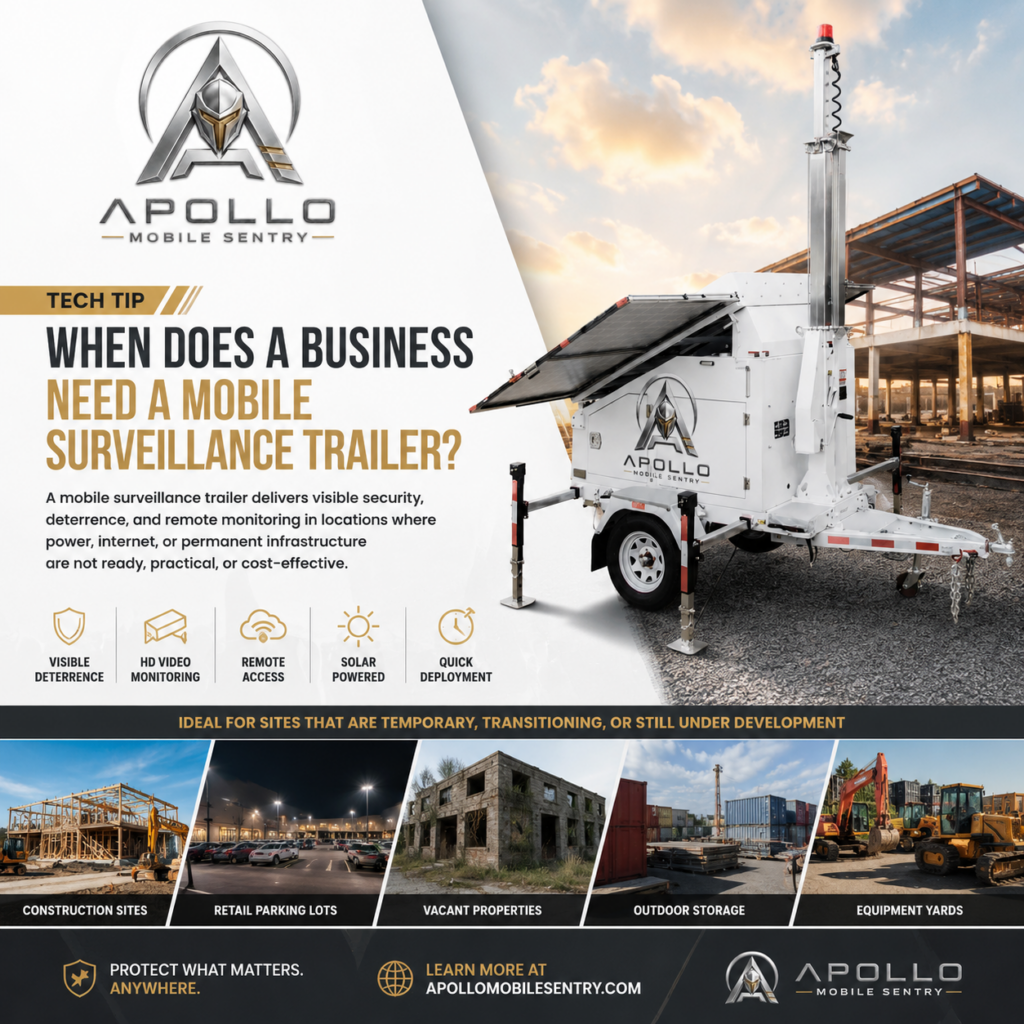
A business needs a mobile surveillance trailer when it needs visible security coverage in a location where permanent cameras, cabling, power, or network service are not ready, practical, or cost-effective yet.
That can include construction sites, retail parking lots, vacant properties, equipment yards, outdoor storage areas, temporary events, or properties waiting on permanent infrastructure.
A mobile surveillance trailer gives the site a temporary or semi-permanent security layer that can be deployed quickly, repositioned when needed, and used while the long-term security plan is still being built.
Why mobile surveillance exists
Not every property is ready for permanent cameras.
Some sites do not have power where coverage is needed. Some do not have internet service. Some are under construction. Some are vacant. Some have changing layouts, temporary fencing, equipment staging, or seasonal traffic patterns.
In those situations, a traditional camera installation may not make sense yet.
Mobile surveillance trailers help bridge that gap. They can provide camera coverage, visual deterrence, lighting, alerts, and remote visibility in places where fixed infrastructure is difficult, delayed, or unnecessary for the long term.
Common use cases
Common places mobile surveillance trailers make sense
Construction sites
Construction sites change constantly. Materials move. Equipment comes and goes. Fencing shifts. Power and network infrastructure may not be available until later phases of the project.
- Equipment staging areas
- Material storage
- Entry points and temporary gates
- Jobsite trailers and parking areas
- Fuel storage, tools, and machinery
Retail parking lots
Retail parking lots can create visibility challenges, especially after hours or in areas where fixed cameras do not reach.
- Temporary crime deterrence
- Parking lot visibility
- Seasonal shopping periods
- Vehicle break-in concerns
- Areas waiting on camera upgrades
Vacant or transitioning properties
Vacant buildings and lots are often difficult to protect because the site may not justify a full permanent installation yet.
- Buildings between tenants
- Properties under renovation
- Outdoor storage areas
- Temporary perimeter concerns
- Sites waiting on utility activation
Outdoor storage and equipment yards
Yards and outdoor storage areas are often large, open, and difficult to cable. A trailer can provide coverage faster and with fewer infrastructure requirements.
- Fleet parking
- Container storage
- Material laydown areas
- Contractor yards
- Remote corners of a property
When a mobile surveillance trailer is better than permanent cameras
A trailer may be the better choice when the site layout is temporary, power is not available where cameras are needed, internet service is not active yet, or the property is under construction.
- The coverage area may move.
- The risk is short-term or seasonal.
- The site needs visible deterrence quickly.
- Permanent cabling would be expensive or premature.
- The property is waiting on a larger security upgrade.
Permanent cameras are still the right long-term answer for many buildings. But there are plenty of situations where installing permanent cameras too early creates wasted work, poor placement, or unnecessary cost.
Mobile surveillance gives the business time and flexibility.
When a trailer may not be the right fit
Mobile surveillance trailers are useful, but they are not the answer for every site.
- The property already has reliable power and network infrastructure.
- Camera locations are fixed and unlikely to change.
- The site needs permanent indoor coverage.
- The building already has proper cabling pathways.
- The long-term camera design is ready to install.
- The site requires discreet cameras rather than visible deterrence.
In those cases, a permanent commercial surveillance system may be a better investment. The decision should be based on the site, the timeline, the risk, and the long-term plan.
Lease or buy
Which makes more sense?
Apollo Mobile Sentry can support both short-term and long-term needs. Leasing usually makes sense when the need is temporary. Buying may make sense when the organization expects recurring or long-term use.
Leasing may fit
- Construction phases
- Short-term parking lot concerns
- Vacant properties
- Seasonal retail traffic
- Interim security during renovations
Buying may fit
- Property groups with multiple sites
- Contractors with ongoing projects
- Industrial yards
- Retail groups
- Organizations with repeated outdoor security needs
What about solar cameras?
Solar cameras are also useful, especially when a site needs coverage in a specific area but does not need a full trailer.
A solar camera may fit when the site needs
- A smaller coverage area
- A single access point or gate view
- A remote corner watched temporarily
- One or two cameras instead of a full trailer
A trailer may fit when the site needs
- Higher visibility
- Multiple cameras
- Stronger deterrence
- Elevated camera views
- Lighting or strobe deterrence
In some cases, a site may use both.
Wireless perimeter protection
Some temporary or outdoor environments need more than cameras.
Wireless alarm systems and perimeter devices can help add another layer of protection around gates, trailers, material areas, or site boundaries.
- Construction sites
- Outdoor storage
- Temporary gates
- Job trailers
- Equipment zones
- Remote property edges
Cameras help provide visibility. Perimeter devices can help create alerts when someone enters an area they should not be in.
What Apollo reviews before recommending mobile surveillance
Apollo does not recommend a trailer just because it looks impressive. Before recommending mobile surveillance, we look at practical site conditions.
Site conditions
What needs to be protected, where activity happens, whether power is available, and whether internet service is active.
Coverage needs
Where cameras would need to be placed, whether the layout is temporary, and how long coverage is needed.
Long-term plan
Whether permanent cameras are planned later, whether alerts or monitoring are needed, and whether leasing or buying makes more sense.
The goal is to match the security approach to the property, not overcomplicate the solution.
Mobile surveillance as a bridge to permanent infrastructure
One of the best uses for mobile surveillance is as a bridge. A business may need coverage now, but the permanent system may not be ready for weeks or months.
- Construction
- Tenant turnover
- Utility delays
- Building renovations
- Network upgrades
- Parking lot camera redesigns
- Property ownership changes
- Security improvement planning
In those situations, a mobile trailer can provide coverage while the permanent infrastructure is being designed and installed. That is often better than rushing a permanent camera installation before the site is ready.
FAQ
Mobile surveillance trailer questions
How long can a mobile surveillance trailer be used?
A mobile surveillance trailer can be used for short-term projects, seasonal needs, or longer deployments. The right timeline depends on the site, security concern, and whether the trailer is being leased or purchased.
Does a mobile surveillance trailer need power?
Many mobile surveillance trailers are designed to operate with solar and battery support, depending on equipment, usage, weather, and deployment conditions. Apollo reviews site conditions before recommending a setup.
Can mobile surveillance trailers be used on construction sites?
Yes. Construction sites are one of the most common use cases because they often lack permanent power, internet, cabling, and camera infrastructure during early or changing project phases.
Are mobile surveillance trailers only for construction?
No. They can also be useful for retail parking lots, vacant properties, property management teams, outdoor storage, equipment yards, temporary events, and locations waiting on permanent security infrastructure.
Should I lease or buy a mobile surveillance trailer?
Leasing usually makes sense for temporary needs. Buying may make sense for organizations that expect repeated or long-term use across multiple locations or projects.
Can Apollo help decide between a trailer, solar camera, or permanent cameras?
Yes. Apollo can review the site, timeline, infrastructure, coverage needs, and budget to help determine whether mobile surveillance, solar cameras, permanent cameras, or a combination makes the most sense.
Need temporary security coverage?
If your site needs camera coverage before permanent infrastructure is ready, Apollo Mobile Sentry can help provide a practical security layer for construction sites, parking lots, vacant properties, equipment yards, and other outdoor areas.