
Apollo Knowledge Magazine · Industrial Corridors Series · 1 of 6
Elk Grove Village and Wood Dale: Build a Network That Supports the Production Floor
A machine is ready, the workstation is installed and the production schedule is set—then the network connection becomes the missing piece. For manufacturers in Elk Grove Village, Wood Dale and Bensenville, a cabling project should start with the production workflow, the physical environment and the people responsible for operating the equipment.

Quick summary
Connect production, shipping and office systems with documented cabling and fiber infrastructure.
Consider a manufacturer moving two machines and adding quality-control displays. The new locations change cable routes, network distribution and maintenance access. Treating the work as a few extra drops can leave the plant with long undocumented runs and no clear handoff. This is an illustrative planning scenario, not a claimed Apollo customer project.
Start with the machine and its owner
List each machine, operator station, printer, quality-control display and supporting camera. Record the connection required by the equipment supplier and identify who owns its configuration. A building-network contractor should coordinate with the plant’s IT team and machine vendor before touching production systems. Adding a data cable does not authorize changes to PLC programming, safety circuits or machine controls. Define those boundaries in the proposal so that an otherwise straightforward installation does not become an unplanned controls project.
Choose pathways for the factory environment
Walk proposed routes while the floor is operating. Look for moving equipment, heat, moisture, vibration and electrical noise, then choose suitable cable, protection and hardware. Fluke Networks describes how electromagnetic interference can disrupt copper signaling and why fiber is useful in electrically noisy environments. Shielded copper is not a universal fix: its selection, installation and bonding require a coordinated design. Keep the route serviceable, protect exposed transitions and identify the responsibilities for conduit, penetrations and access equipment.
Use distribution points intentionally
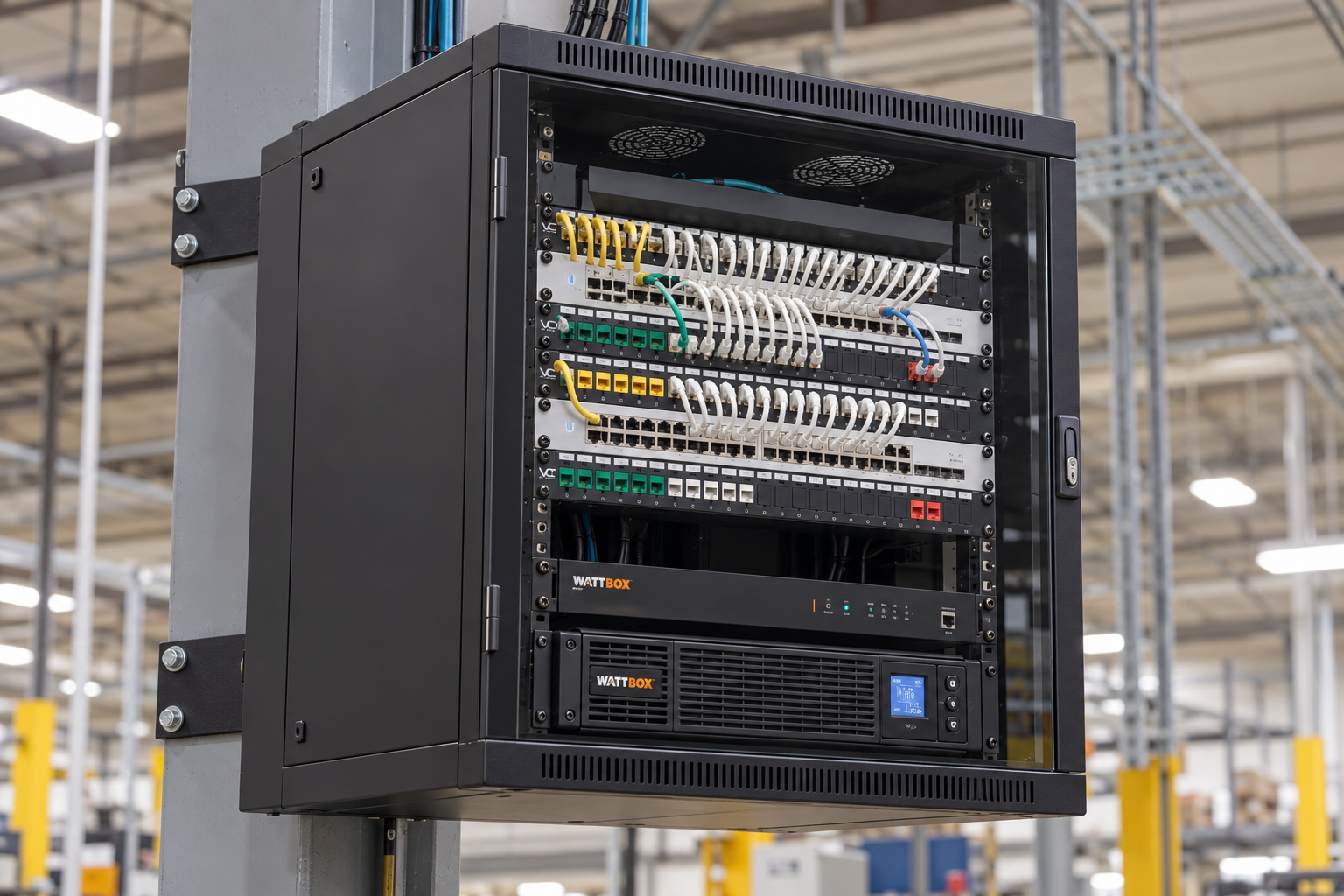
A convenient wall is not automatically the right location for an industrial network cabinet. Review the distances to endpoints, backbone capacity, environment, power and maintenance clearance. Fiber can connect distribution locations without carrying an electrical data signal between them, but the fiber type, optics, connectors and equipment ports still need to match. Specify the installed strands, the working links and the spare capacity separately. Retain useful existing infrastructure only after its condition and suitability are understood.
Coordinate cameras, Wi-Fi and paging
Production support systems often share the same pathways and network equipment. Camera recording adds traffic and storage requirements; access points and cameras may depend on switch PoE capacity. Paging has its own zoning and intelligibility needs. Reviewing these together can reduce repeat lift visits and ceiling work. It does not mean placing every system on one unrestricted network. Ask the IT owner to define segmentation, administration and authorized access before devices are connected.
Accept the job with evidence
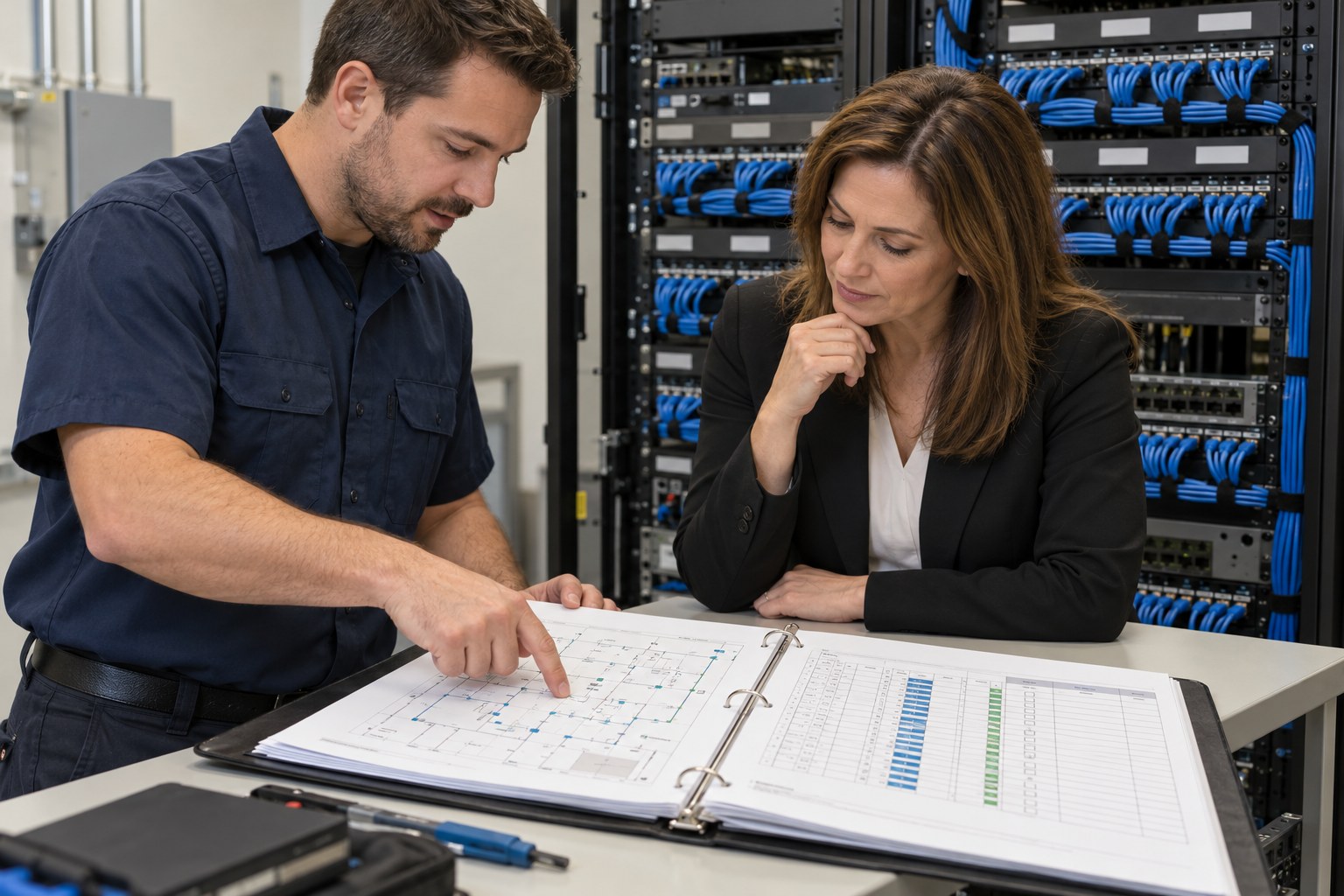
Agree on the required cable-testing scope before installation. A link light confirms a connection, not compliance with a specified cabling performance standard. Request labeled endpoints, test records, cabinet photographs and an updated port schedule. Schedule the production cutover with the machine vendor and plant manager, record what was tested and identify any exclusions. The practical finish line is an operating connection with an owner and documentation—not simply a cable disappearing into a machine enclosure.
Compare the operating result, not just the device list
An equipment list
Quantities and model numbers do not establish pathways, retained-equipment assumptions, interruption windows, account ownership or a tested handoff. Resolve those omissions before comparing totals.
An agreed installation scope
Request locations, infrastructure, responsibilities, compatibility checks, acceptance criteria, documentation and recurring charges. Evaluate proposals against the same operating requirements.
Your project checklist
- List endpoints and machine-vendor requirements.
- Confirm routes, environmental conditions and protection.
- Define cabinet, fiber, switch and PoE responsibilities.
- Agree on the shutdown window and rollback plan.
- Require test results and a labeled handoff.
Frequently asked questions
Does Apollo program production machinery?
This article concerns commercial low-voltage infrastructure. Machine programming, controls and safety-system work require separately defined responsibility with the qualified equipment team.
Should every factory connection use shielded cable?
No. Select the cabling system for the environment, equipment requirements and coordinated installation design.
When does fiber make sense?
Consider backbone distance, capacity, electrical interference and equipment compatibility before selecting fiber and optics.
Can existing cabling remain?
Potentially. Inspect and test it against the intended use before including it in the retained scope.
Can work happen while production continues?
Plan separated work zones and approved interruption windows with plant management; some tasks still require downtime.
Which nearby communities does this guide cover?
This production-floor guide focuses on Elk Grove Village, Wood Dale and Bensenville. Apollo can discuss the site-specific scope for facilities throughout the surrounding Chicagoland area.
Plan your industrial infrastructure with Apollo
Apollo Technology & Cabling plans and installs structured cabling, fiber, business Wi-Fi, surveillance, access control, intercoms, commercial AV and paging for Chicagoland businesses. Share your floor plan, operational concerns and timeline so the scope can be built around your facility.
For facilities in Elk Grove Village, Wood Dale, Bensenville, Illinois, request a project assessment or call 331-256-8330. Scheduling and the site-specific scope will be confirmed with your team.
Explore industrial structured cabling and fiber installation, business Wi-Fi and network hardware, facility paging and break bells, and manufacturing infrastructure planning.
Technical reference: Fluke Networks: electromagnetic interference in industrial cabling.