
Apollo Knowledge Magazine · Industrial Corridors Series · 5 of 6
Elmhurst, Villa Park and Lombard: Modernize an Industrial Network Without Losing Its History
An established facility can have good equipment connected through years of undocumented changes. A spare patch cord solves today’s problem and becomes tomorrow’s mystery. For industrial buildings around Elmhurst, Villa Park and Lombard, a retrofit should establish what exists, what remains useful and how improvements will be introduced without an avoidable interruption.
Quick summary
Audit existing infrastructure, define what to retain and stage network-room improvements around operations.
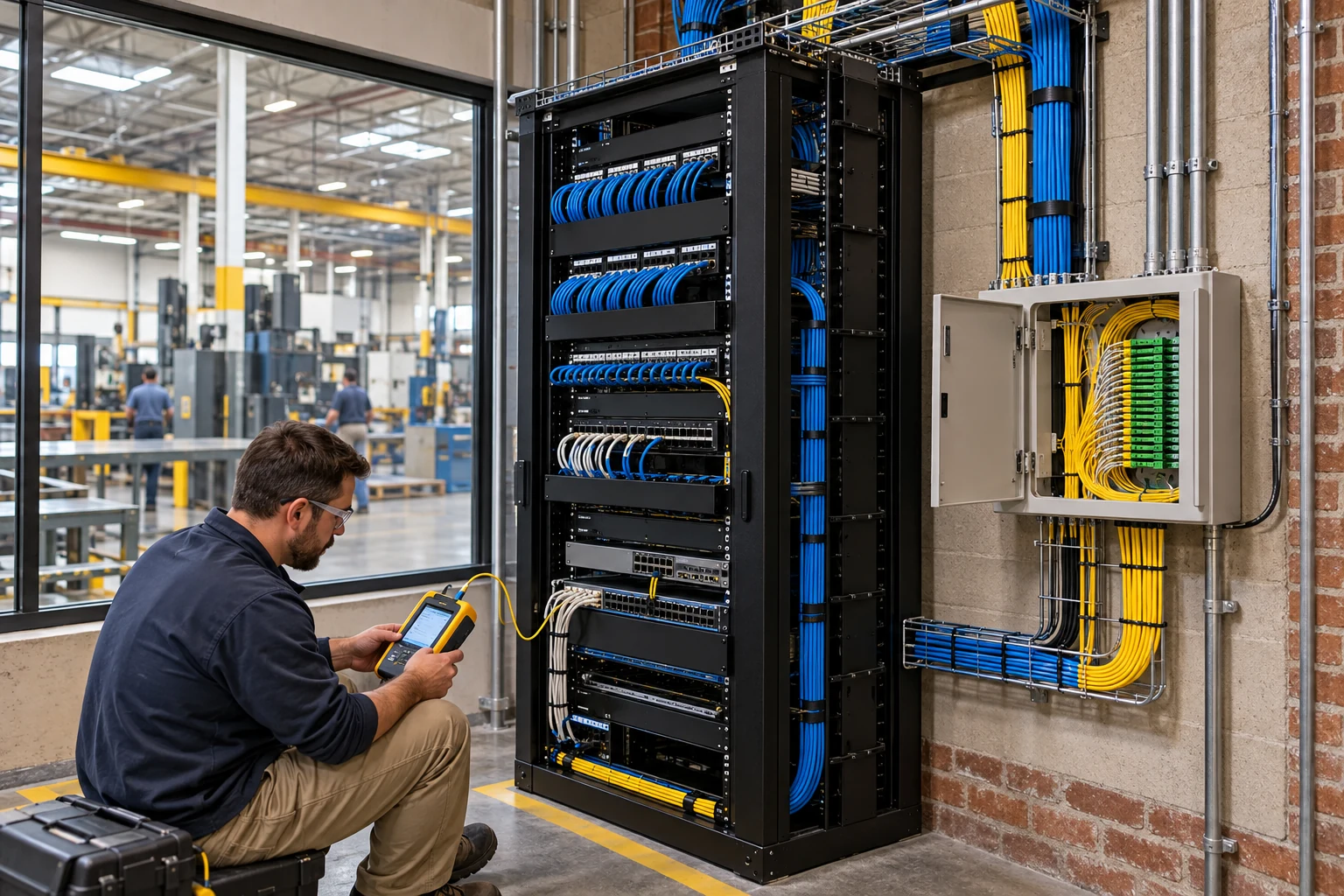
Picture a mixed warehouse and production building whose rack has grown through several tenant and equipment changes. Some links are critical, some are abandoned and nobody has a current port map. Similar questions arise in Glen Ellyn, Oakbrook Terrace, Hillside, Westchester and Broadview. This is a planning scenario, not a claim about a specific customer property.
Start with an inventory, not a cleanup day
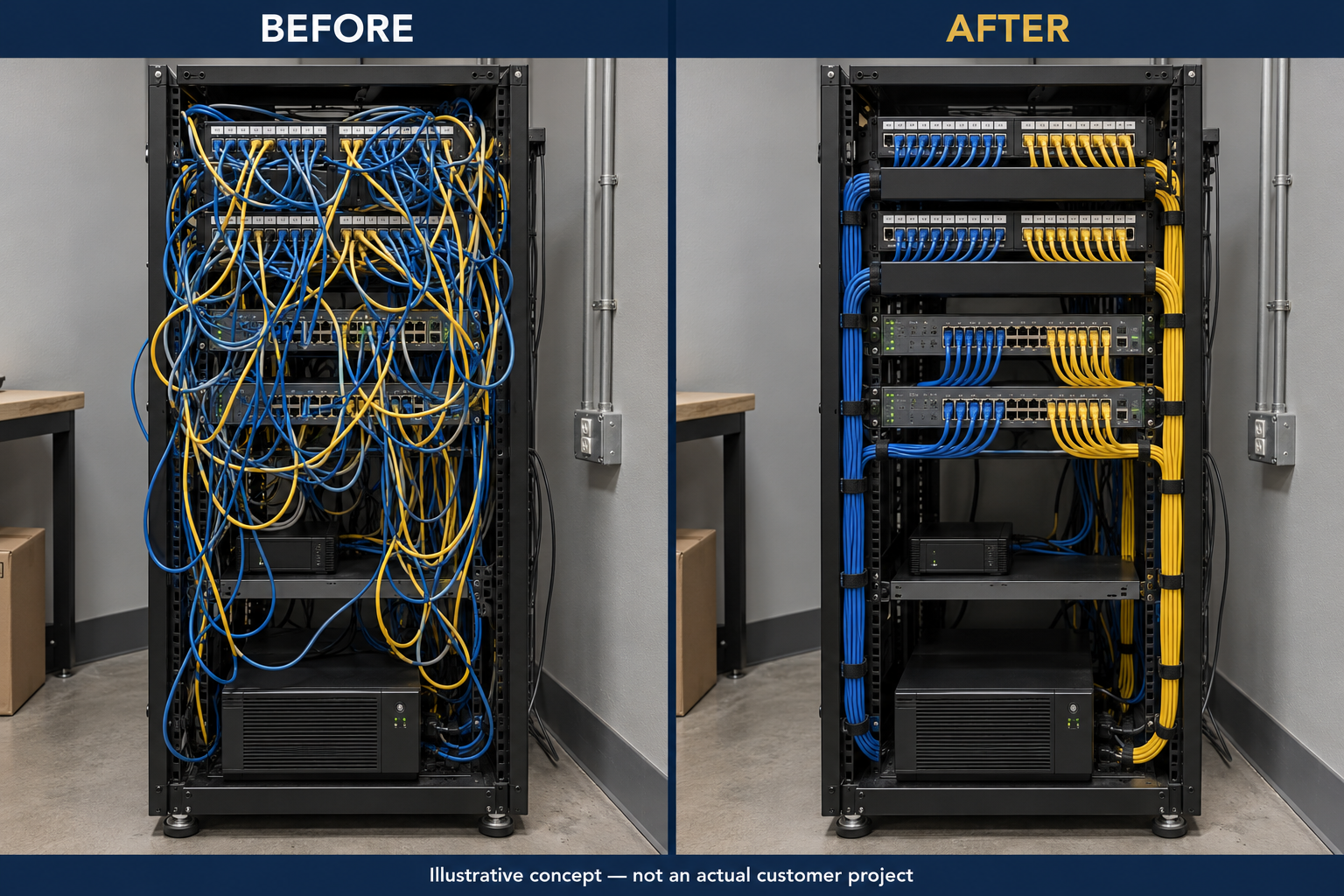
Photograph the existing cabinet, label known endpoints and identify who owns each connected system. Ask staff which connections support production, shipping, phones, cameras and building systems. Trace unknown circuits before removing or moving them. A cable that appears idle may serve an infrequently used endpoint. The first deliverable should be an agreed record of the current state and the unresolved questions, giving the business a basis for choosing a manageable first phase.
Test before deciding what to retain
Age and appearance alone do not establish cable performance. Select testing that matches the intended application and document the results. A basic continuity check and a standards-based certification test answer different questions. Review connectors, pathways and physical condition alongside measurements. Retained links should have a defined purpose, identity and acceptance basis. Fluke Networks notes that industrial cabling must account for factory conditions; a successful office link does not automatically prove suitability for every production environment.
Plan power, cooling and working access
A neater rack can still have inadequate power, poor ventilation or inaccessible service points. Inventory switches, recorders, optics and PoE loads before moving them. Review the equipment environment and have appropriate specialists assess electrical work where needed. If backup power is included, define the equipment being supported and test runtime at a representative load. A UPS on the switch does not guarantee an entire business application stays available when other dependencies lose power.
Stage the work around the operation
Divide the project into traceable groups of endpoints. Confirm the affected departments, approved interruption window and person authorized to accept each cutover. Preserve a current record of the previous connections and define how the team will restore service if an agreed check fails. Schedule a production link with its owner rather than moving it opportunistically during a tidy-up. Combining planned cable work with camera, Wi-Fi or paging changes can make installation access more efficient, provided responsibilities stay clear.
Hand over a system people can maintain
Use consistent labels at the patch panel and endpoint, provide a port schedule and retain test records. Review the documentation with the employee or IT partner who will maintain it. Identify remaining limitations honestly: a completed rack phase may not solve an upstream internet problem or a machine-vendor issue. Set a process for recording future changes. The most valuable result is infrastructure the next technician can understand without rediscovering every connection.
Compare the operating result, not just the device list
An equipment list
Quantities and model numbers do not establish pathways, retained-equipment assumptions, interruption windows, account ownership or a tested handoff. Resolve those omissions before comparing totals.
An agreed installation scope
Request locations, infrastructure, responsibilities, compatibility checks, acceptance criteria, documentation and recurring charges. Evaluate proposals against the same operating requirements.

Your project checklist
- Inventory connected systems and unknown links.
- Agree on retained-cable testing and acceptance.
- Review environment, PoE, power and backup scope.
- Assign cutover windows and rollback ownership.
- Deliver labels, test records and an updated port map.
Frequently asked questions
Does a retrofit require replacing every cable?
No. Keep suitable infrastructure when inspection and the agreed testing support its intended use.
Is cable cleanup the same as certification?
No. Appearance, continuity and performance certification are separate matters.
Can Apollo coordinate with our IT provider?
Define configuration, cabling and cutover responsibilities with your IT team in the project scope.
Should abandoned cables be pulled immediately?
First trace and confirm their status, then coordinate any removal requirements and safe access.
Will a UPS keep every operation online?
Only the supported equipment and dependencies within the verified backup scope can be assessed for that outcome.
Where does this retrofit guide apply?
Elmhurst, Villa Park, Lombard, Glen Ellyn, Oakbrook Terrace, Hillside, Westchester and Broadview are included in this regional planning guide.
Plan your industrial infrastructure with Apollo
Apollo Technology & Cabling plans and installs structured cabling, fiber, business Wi-Fi, surveillance, access control, intercoms, commercial AV and paging for Chicagoland businesses. Share your floor plan, operational concerns and timeline so the scope can be built around your facility.
For facilities in Elmhurst, Villa Park, Lombard, Glen Ellyn, Oakbrook Terrace, Hillside, Westchester, Broadview, Illinois, request a project assessment or call 331-256-8330. Scheduling and the site-specific scope will be confirmed with your team.
Explore structured cabling, fiber and network-room organization, business Wi-Fi and network hardware installation, and manufacturing infrastructure planning. Review our structured cabling cost guide before comparing retrofit proposals.
Technical reference: Fluke Networks: industrial Ethernet fundamentals.